Symbolism of the Immaculate Heart of Mary
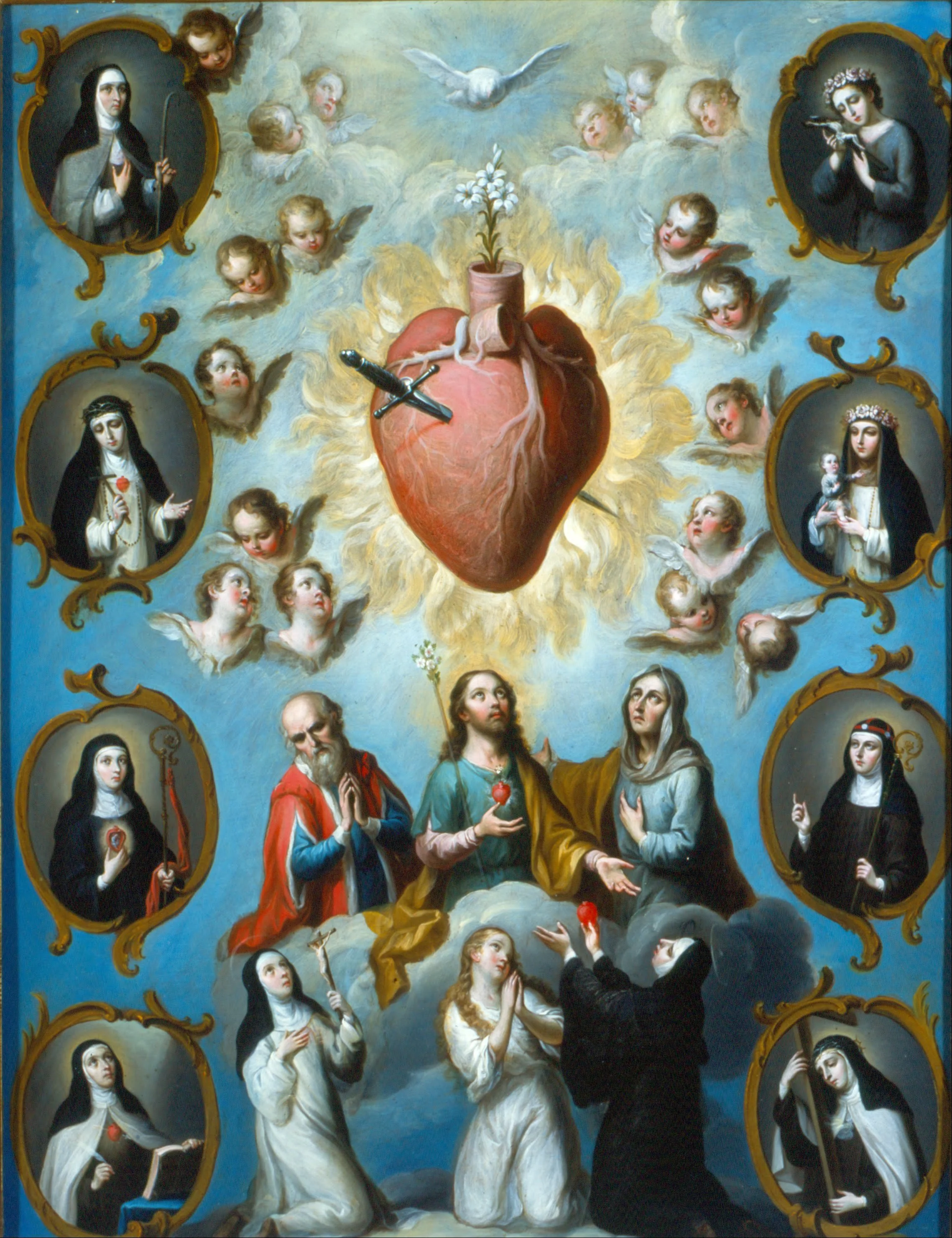
Juan Patricio Morlete Ruiz, The Heart of Mary, 18th century
“Awake, O my harp, thy chords, in praise of Mary the Virgin. Lift up thy voice, and sing the generation utterly marvelous of this Virgin, David’s daughter, who hath brought forth life to the world” declaims Saint Ephrem the Syrian, called the ‘Harp of the Holy Spirit,’ in his 4th-century hymn on the Blessed Mary. He continues: “Lo, a Virgin is become a Mother, preserving virginity with its seals unbroken…She is made God’s Mother and is at the same time a servant, and the work of His wisdom…”
Writing about the Immaculate Heart of Mary which is a sacred treasury and fountain of graces and in many ways a great mystery, and in particular its representation in sacred art, which is itself a glorious treasure-house of tradition and beauty, I approach humbly. I ask the most humble of all women, Mary herself, to illuminate those aspects of her Immaculate Heart that she wishes to share with you and to curate the art that will be our point of entry into its mysteries.
Immaculate. This title for Mary’s heart refers to the dogma of the Immaculate Conception, how Mary was preserved from all stain of original sin in order to become the God-bearer, the new arc of the Covenant. Under this title we contemplate Mary’s purity, her fullness of grace as proclaimed by the Archangel Gabriel, and her fulfillment of the prophecy from Genesis 3:15: “I will put enmity between you and the woman, and between your offspring and her offspring; he shall bruise your head, and you shall bruise his heel” (ESV).
It is to express Mary’s singular purity and the way that it flowered into a garden, a new Eden, for the Incarnation of God Himself, that many images of the Immaculate Heart include white lilies. The other flowers often represented, roses, bear a similar symbolic meaning in reference to one of Mary’s titles from the Litany of Loretto: ‘Mystical Rose.’ Roses throughout sacred Scripture are associated with the fulfillment of God’s promises (Isaiah 35:1-2; Song 2:1), while the title ‘rose without thorns’ poetically communicates her Immaculate Conception.
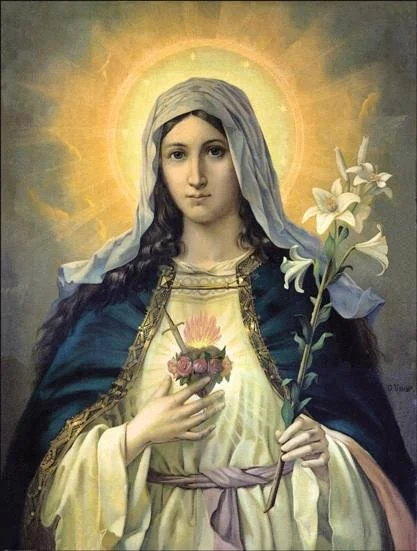
Oswald Völkel, Immaculate Heart of Mary, 1920s
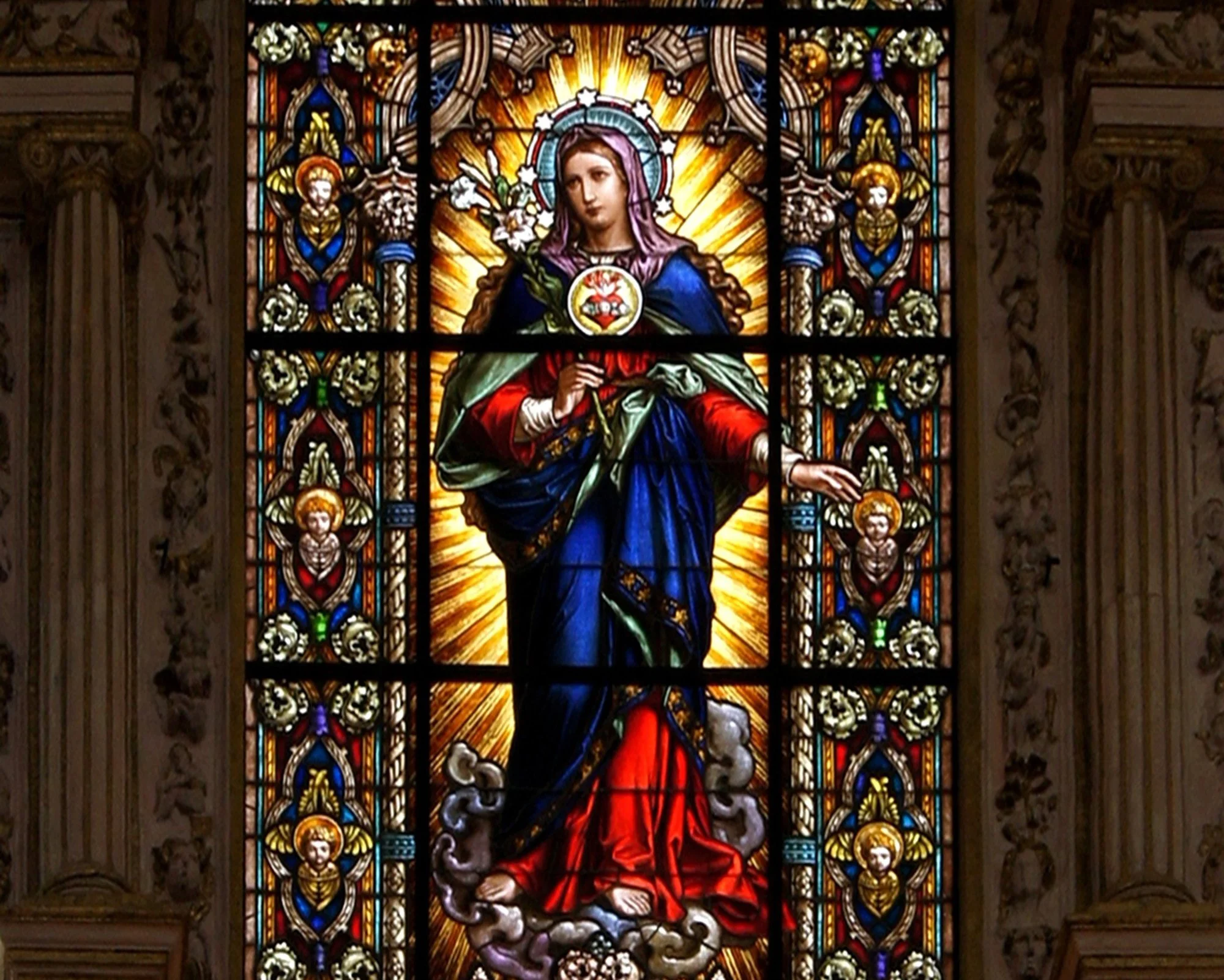
In Oswald Völkel’s Immaculate Heart of Mary we see both floral symbols: pink roses garlanding Mary’s Heart and a branch of white lilies in her hand. This is likewise true in the beautiful stained glass window depiction in the Cathedral of Cordoba, Spain, from the same period, shown below.
Heart. Before we go further, let us not take for granted the meaning of this word. In sacred Scripture as in ancient near-eastern culture, the heart was not predominantly symbolic of passions or affections such as are expressed by Valentine’s Day candies. The heart is the seat of the will, and the place where thought and memory are conceived and carried. In the Gospel of Luke, Simeon prophesizes to Mary: “and a sword will pierce through your own soul also, so that thoughts from many hearts may be revealed” (Luke 2:35, ESV). Later, following the exchange with the child Jesus after he was found in the Temple, we read: “And his mother treasured up all these things in her heart” (Luke 2:51, ESV).
When we think about Mary’s heart (or soul) we must consider the combined powers of her will, intellect, and feelings – all these dimensions of her humanity at once. The artistic tradition of representing of Mary’s physical heart seeks to communicate her whole heart and soul: her fiat at the Annunciation (will), her pondering of the words and actions of Jesus in her heart (intellect), as well as all of her joys and sorrows (feelings).
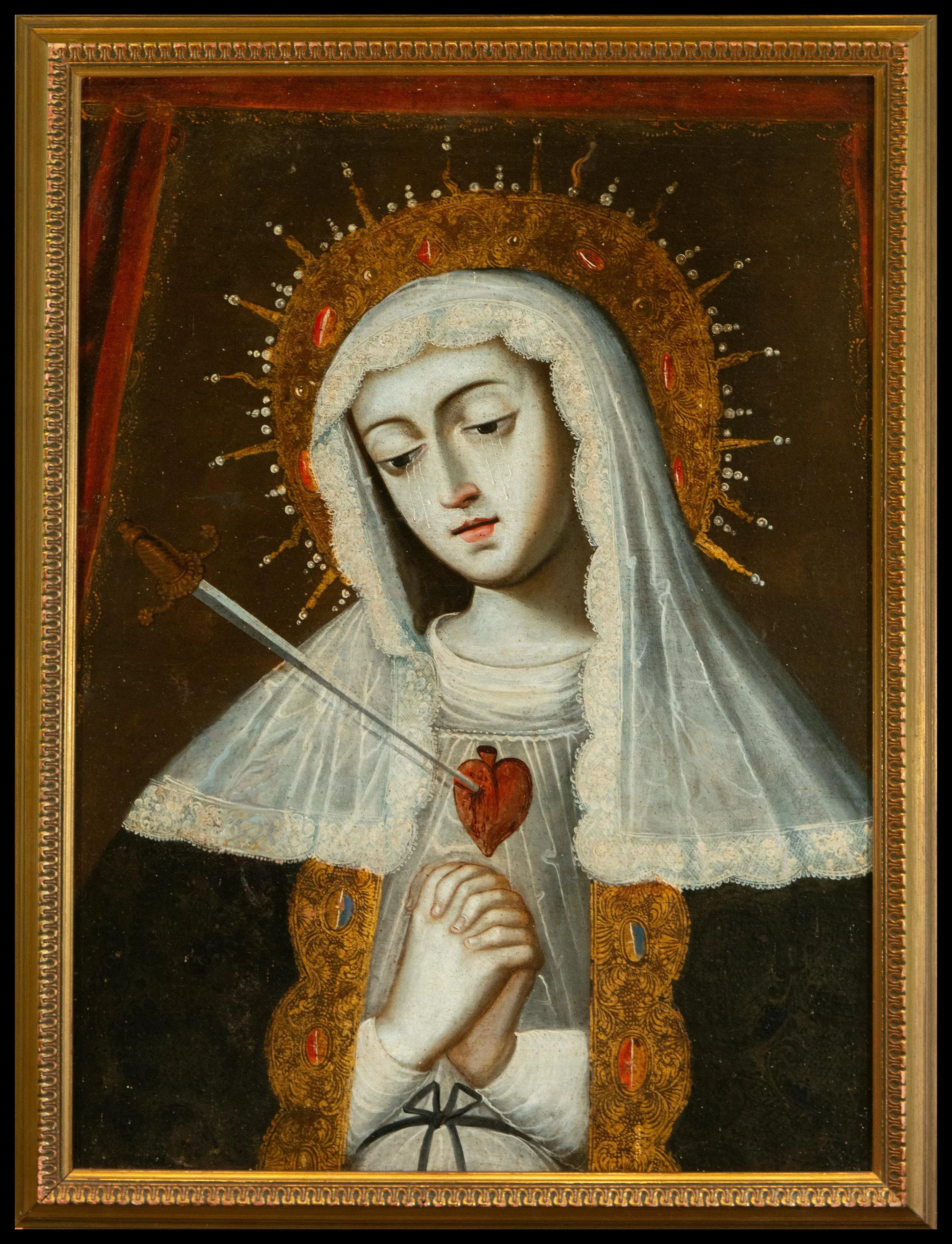
Our Lady of Sorrows, Cuzco or Quito Colonial School, 17th Century
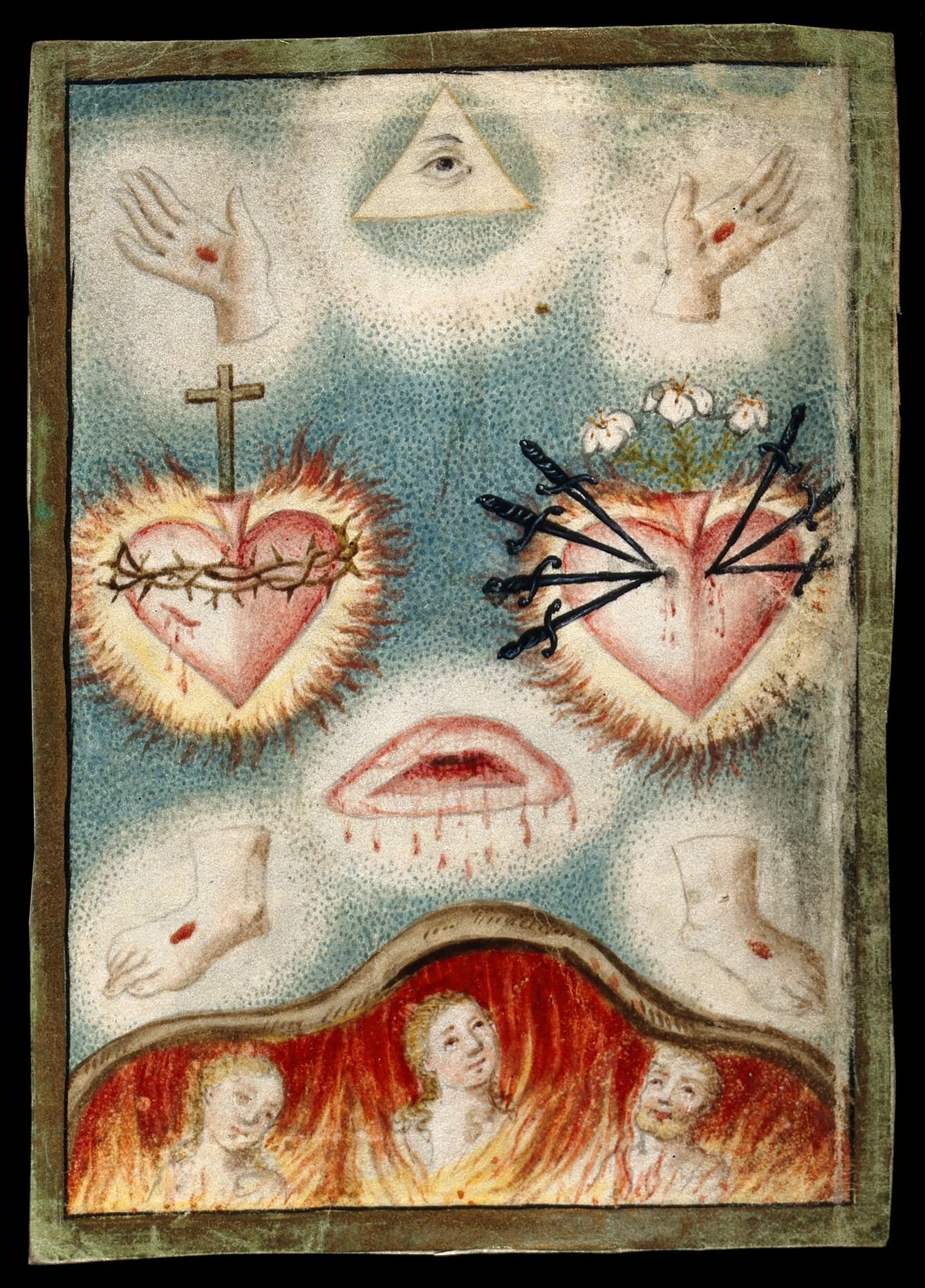
Souls in Purgatory Looking at the Sacred and Immaculate Hearts, artist unknown, 18th century
While devotion to the heart of Mary has its roots in the beginning of our Christian tradition and flowered in the middle ages with saints like Mechtilde, Gertrude the Great, and Bridget of Sweden, it was not until the 17th century, following St. John Eudes’ promotion of devotion to the Immaculate and Sacred Hearts, that artists began to represent the physical heart of Mary alongside Jesus’ heart and His holy wounds as shown in this 18th-century watercolor. The intense physicality we see in sacred art, especially from the Middle Ages, of the wounds and heart of Christ helps us to appreciate the reality of God’s incarnation and salvific suffering and His total gift of Himself to us. The representation of Mary’s heart likewise draws us to consider her real, physical, human, maternal love and suffering.
In sacred art the sword that pierces the heart of Mary pictorially represents the sword prophesied by Simeon; in devotion to Our lady of Sorrows this symbol is elaborated to number seven corresponding to Mary’s sorrows from Scripture:
The Prophecy of Simeon (Luke 2:34-35)
The Flight into Egypt (Matthew 2:13-21)
The Loss of Jesus for Three Days (Luke 2:41-50)
The Carrying of the Cross (John 19:17)
The Crucifixion of Jesus (John 19:18-30)
Jesus Taken Down from the Cross (John 19:39-40)
Jesus Laid in the Tomb (John 19:39-42)
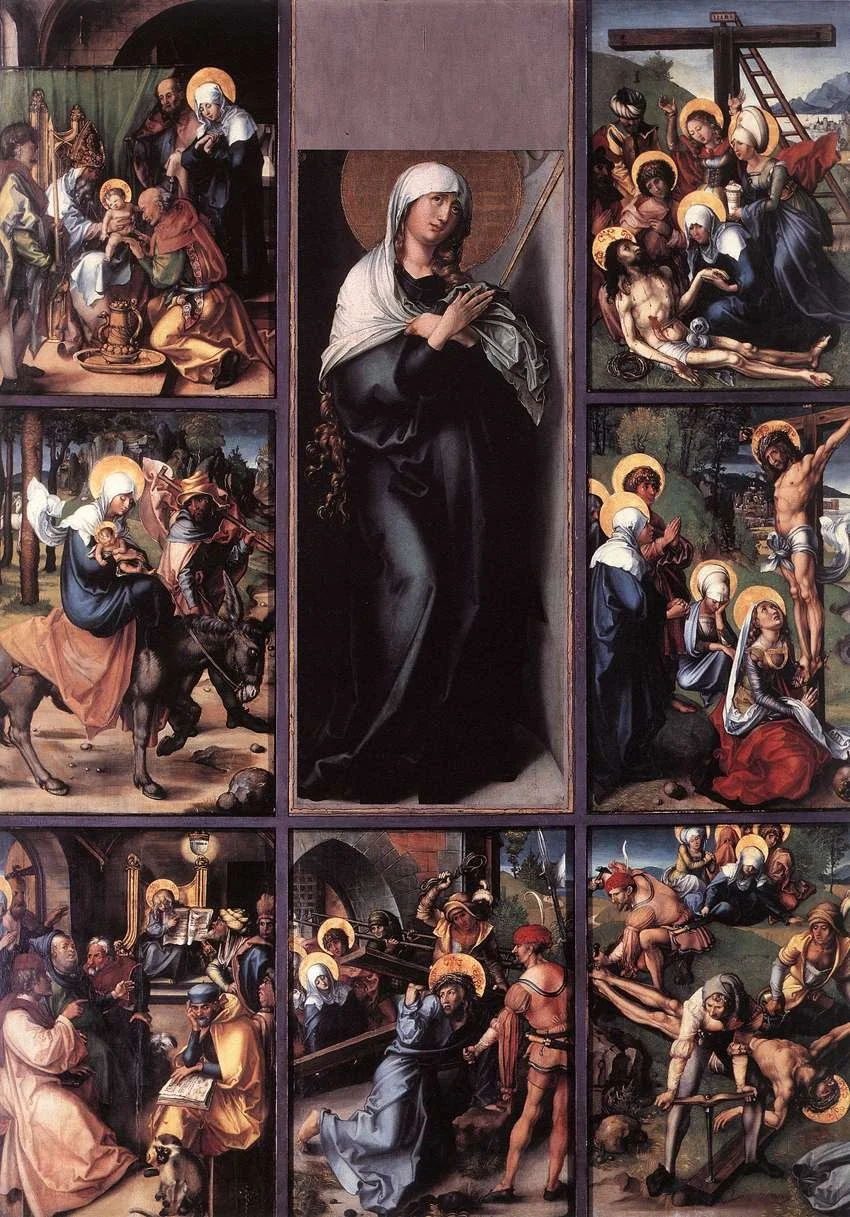
Albrecht Dürer, Seven Sorrows Polyptych, c. 1500
The swords piercing Mary’s heart express her profound suffering in union with her Son. Moreover, they suggest her bloodless martyrdom. In a meditation on her sorrows, Saint Bonaventure addresses the blessed Virgin:
Oh Lady, why hast thou wished to go and sacrifice thyself also on Calvary? Was not a crucified God sufficient to redeem us, that thou his mother wouldst be crucified also? Indeed, the death of Jesus was more than enough to save the world, and also an infinity of worlds; but this good mother wished, for the love she bore us, likewise to aid the cause of our salvation with the merits of the sorrows which she offered for us on Calvary. And, therefore, says the blessed Albertus Magnus, as we are indebted to Jesus for what he suffered for love of us, we are also to Mary for the martyrdom which she, in the death of her Son, voluntarily suffered for our salvation.
Immaculate Heart of Mary,
Pray for us!
